Apple Pie
🦞 ClawdBot MoltBot OpenClaw
With the exciting, and arguably dangerous rise in the personal, less constrained AI agents on the rise, OpenClaw has taken this market by storm, and recently acquired by OpenAI.
I was surprised to see that Anthropic didn't make this strategic acquisition, but it is what it is.
Security
I'm not going to talk much about security of personal AI Agents in this thought, I'll save that for another time.
What is OpenClaw
For those not familiar, OpenClaw is an open-source project that describes itself as:
OpenClaw is a personal AI assistant you run on your own devices. It answers you on the channels you already use (WhatsApp, Telegram, Slack, Discord, Google Chat, Signal, iMessage, Microsoft Teams, WebChat), plus extension channels like BlueBubbles, Matrix, Zalo, and Zalo Personal. It can speak and listen on macOS/iOS/Android, and can render a live Canvas you control. The Gateway is just the control plane — the product is the assistant.
If you want a personal, single-user assistant that feels local, fast, and always-on, this is it.
Exciting! I want one.
I decided to spin up an instance on my home Proxmox server to give this new tool a whirl to see if it lived up to the hype. There was (and still is) a LOT of hype
I create a new debian lxc, and ran the script presented on the OpenClaw homepage.
I followed the modern TUI install experience, defined a few things like my OpenAI API Key (recently cancelled my Claude subscription. Will likely open another one in a week. I'm so undecided about which model I should be using), and decided that the easiest interface would probably be Telegram.
That was easy enough to set up, I've chatted with the @BotFather before and have made Telegram bots for various other purposes.
Once that was all set up, I was like "Cool, it seems to work. Now what".
What am I going to use it for?
The novelty was ripe. I was expecting amazing things. Expecting my world to become 30% easier, everything to be done for me.
In reality, that's never the case of course. You have to prepare these systems to be able to provide value for you.
I started thinking about granting it all the keys, but was cautious to have a lobster running around my digital-apartment with a large, loud jangly keychain attached to its... waist? I digress.
"Hello"
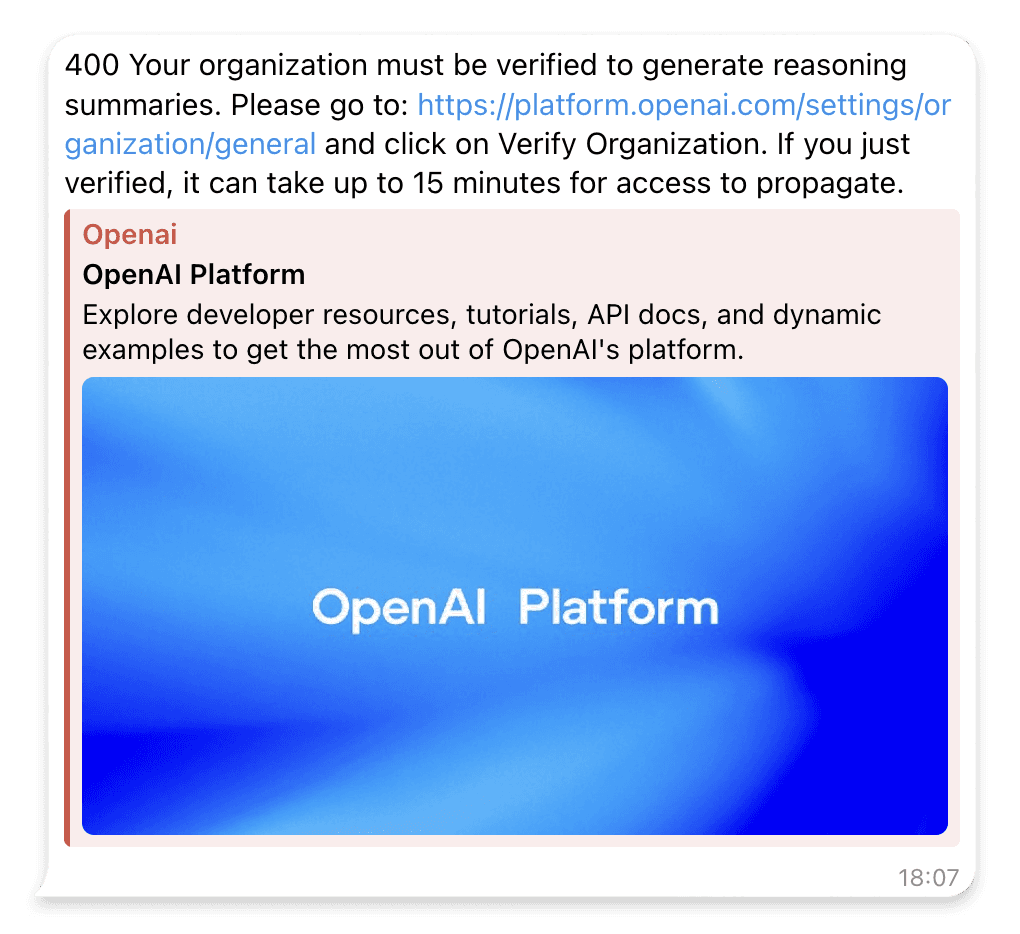
Great. No idea what that means, so I went into my OpenAI Platform and tried to resolve that. Not complicated, an unexpected blocker as I had been using the OpenAI API for a while now in other projects.
Let's try an actual task:
I want you to install fit if it's not already installed and then generate an ssh key using ssh-keygen. No need for a passkey, just use the defaults
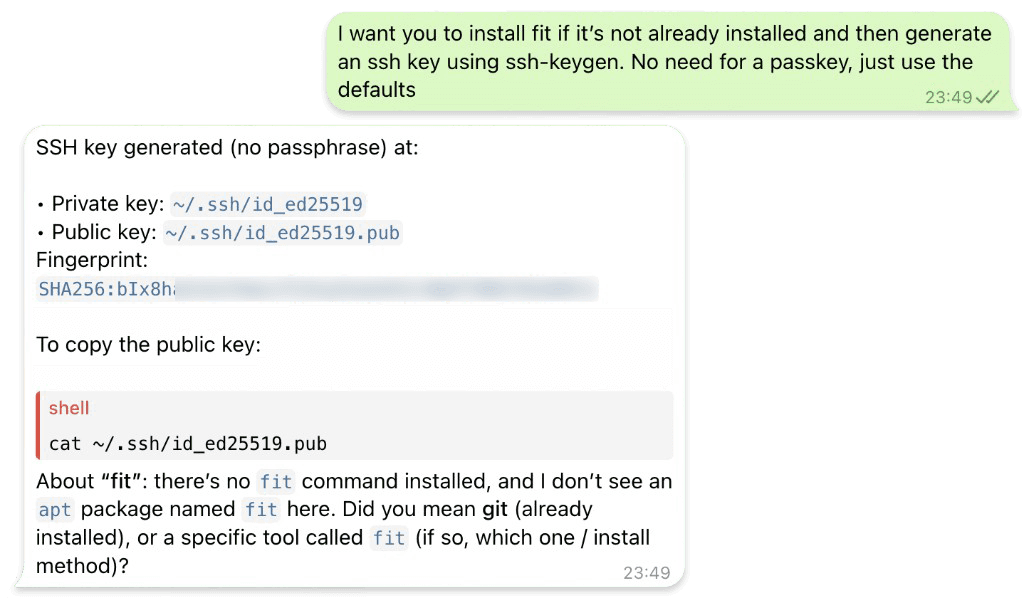
Turns out typing in the telegram UI, using the developer beta of iOS 26 (known for very suspect keyboard hit-areas) was amusing, but it got the idea.
My first independent coding employee
I thought I would create it's own GitHub account, and grant it access to some of my repositories. That way it could help me on some of my projects.
I did so, and that created a problem.
Progressing personal projects... from bed.
It was wild to me that I could direct this AI to raise PRs in my projects with tweaks to middlewares, UI, copy etc.
Honestly, it's probably not the most healthy habit but I'm sure I'll calm down when the hype also does.
So why is this called Apple Pie?
Fair enough, I've been giving too much context. Too much dribble. Back to the actual topic I wanted to write about:
The Apple Mac Mini has come under exceptionally high demand.
In Belgium, it's base price is €717. That's quite a lot of money to drop on some hardware for a hype project.
I have been in the market for personal Mac, but was really leaning towards getting a MacBook Air, or Pro for portability, so hadn't made the jump.
The benefit of the Mac Mini, in the context of OpenClaw is as follows:
- Very friendly OS UI. People know how to use a Mac and can plug it into their machine. Very shallow barrier to entry there.
- Reliable OS
- Very good bang for your buck from a hardware perspective
- OpenClaw offers some Apple-only skills/integrations. Namely iMessage, Notes, Calendar, Reminders etc. That hooks well into the Apple ecosystem, and your iPhone.
- Can just be left on 24/7 (Small footprint, low power consumption)
In theory, and perhaps what I would be interested in eventually, is the ability to run an LLM at home. No need to rely on the ever-increasing token costs of OpenAI and Anthropic (other models are available).
What the Apple Mac Mini actually offers, aside from the apple ecosystem is that separate piece of hardware, that can do these jobs for you.
What about the Pie bit...
Well, in my case, I installed OpenClaw on my Proxmox VM. Works well, can give it whatever resources I want, I feel like I have more control over it's capabilities and I already had a server up and running. It was about 10 minutes from "I want to try OpenClaw" to me giving it my OpenAI API key.
So I went that route.
But I appreciate, not many people have a Proxmox cluster at home.
So what other alternatives could I use?
What about Raspberry Pi?

It seems like it's perhaps not just me that had that thought.
Every re-seller of Raspberry Pi's in Belgium is out of stock.
Wild.
A Raspberry Pi in Belgium costs €67.
Yes, that's a factor of 10 cheaper than a Mac Mini.
Apples to Apples
I suppose in conclusion, it's interesting to me that more normal people are diving into the world of hosting things at home, even if that is buying a second computer not as your daily driver, but as a workhorse.
That kind of thinking was reserved for us nerds.
You can't really compare a Raspberry Pi to a Mac Mini in terms of traditional computing, but this isn't traditional computing.
Your need is a piece of internet connected hardware, that can perform tasks for you.
Perhaps if you can't afford a Mac Mini, give a Raspberry Pi a go, if you can get your hands on one!